I want care available on site
Close-care housing
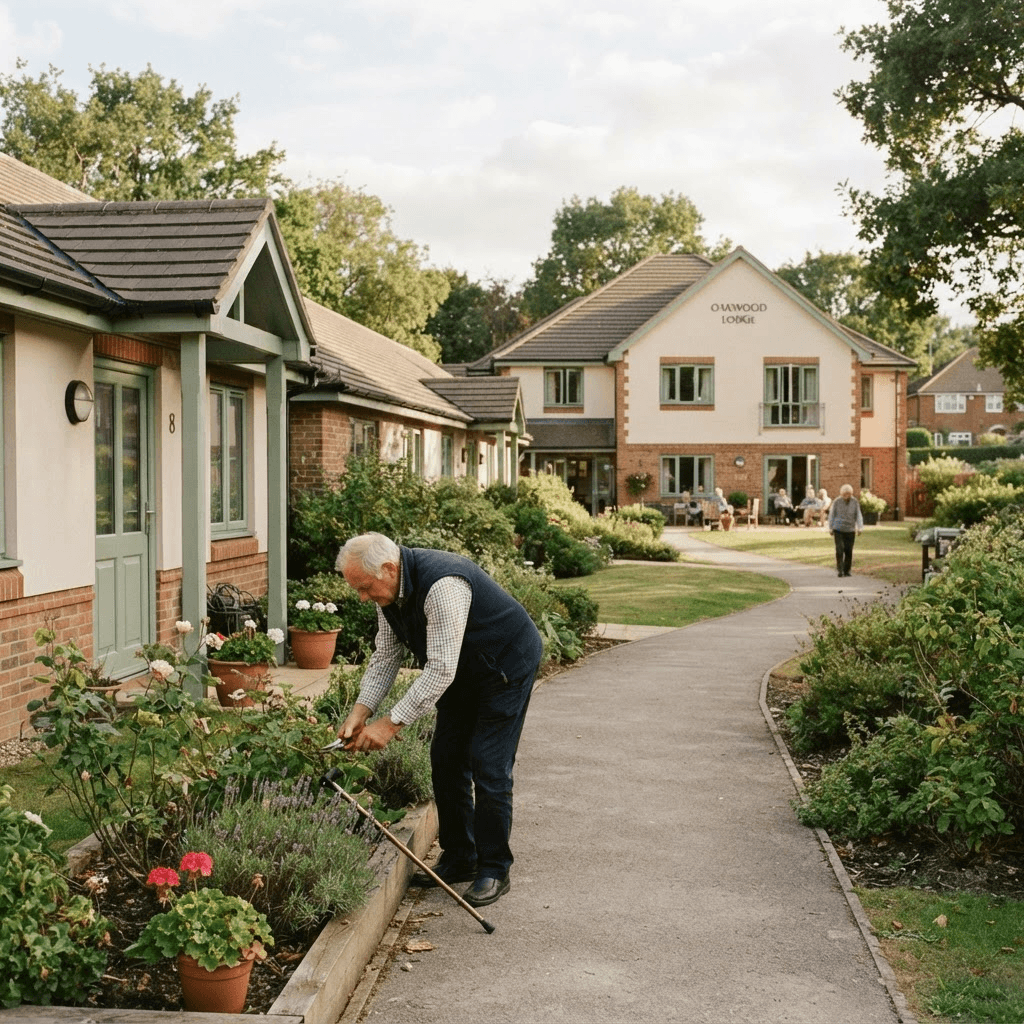
Independent homes built beside or within the grounds of a care home, giving residents access to services from the care provider while keeping their own home.
Also called: Care-home linked housing
The relationship with the adjacent care home varies by site — never assume services transfer automatically.
- Reviewed
At a glance
- Who it may suit
- People who want an independent home now, with an established care setting immediately at hand.
- Home arrangement
- Usually a flat or bungalow beside or within the grounds of a care home.
- Support usually available
- Services such as meals, laundry or emergency response are often available from the neighbouring home, usually charged.
- Personal care
- Often available from the care home's team by arrangement; the scope varies site by site.
- Typical tenure
- A mix of leasehold purchase and rental, depending on the operator.
- Age or eligibility
- Set by the operator; often linked to the care home's admission approach.
What close-care housing usually means
Close-care housing means independent homes — usually bungalows or flats — built next to or within the grounds of a care home. Residents live independently but can buy services such as meals, laundry, emergency response or personal care from the neighbouring home.
The defining feature is the relationship with the care home, and that relationship varies enormously. On some sites, close-care residents have priority access to the home if their needs change; on others, no such priority exists. The services available, their charges, and any transfer arrangements are all site-specific.
Because close-care housing is a smaller market than the other types listed here, inventory can be limited in many areas. Where no suitable close-care option exists nearby, extra-care housing often serves a similar purpose.
Terms used here: personal care, tenure.
What to expect
Typical arrangements — the individual scheme or home always determines what is actually offered.
Your home
- Usually a self-contained bungalow or flat on or beside the care-home site.
- Homes are typically accessible and low-maintenance by design.
- Shared facilities may be the care home's own — dining room, gardens, activity space.
- Check with the provider which facilities residents may use, and on what terms.
Support and care
- Services from the care home — meals, laundry, response — are usually available and charged.
- Personal care can often be arranged from the home's team; scope varies by site.
- Priority transfer to the care home if needs change exists on some sites only.
- Check with the provider exactly what the care relationship includes.
Costs, tenure and eligibility
- Homes may be leasehold purchases or rentals, depending on the operator.
- Expect service charges plus per-service fees for anything from the care home.
- Entry criteria are operator-set and often mirror the care home's approach.
- Check with the provider the full charge list and any transfer arrangements.
Is it likely to suit you?
There is no single right answer — these questions are meant to help you reflect, not to assess you.
- Do you want to live independently with an established care setting next door?
- Would services like meals or laundry from the care home be genuinely useful?
- Does the site offer any priority if you later need the care home itself?
- Are you looking to buy or rent?
- Is the combined cost of home plus purchased services affordable long-term?
Often confused with
Close-care housing or extra-care housing?
Extra care builds the care team into the housing scheme itself; close care relies on services purchased from a neighbouring care home.
The home
- Close-care housing
- Self-contained flat within one care-staffed building.
- Extra-care housing
- An accessible flat within a larger scheme staffed by an on-site care team, rented or owned.
Care and support
Personal care usually available on site when needed.
Close-care housing or care homes?
A care home provides accommodation and care as one package; close-care residents keep a fully independent home.
The home
- Close-care housing
- A furnished room within a staffed residential home.
- Care homes
- A furnished room, usually with private bathroom, within a staffed home providing daily personal care.
Care and support
Personal care is part of daily life; nursing in some homes.
Questions to ask providers
Worth asking about any scheme or home you are considering — print this page and take it with you.
What services can you buy from the care home, at what cost?
Service lists and charges are entirely site-specific.
Do close-care residents get priority for the care home itself?
Priority transfer exists on some sites and not others.
What are the tenure terms and current charges?
Leasehold and rental terms vary by operator.
Who maintains the home and grounds?
Responsibilities differ between operator and resident.
What eligibility rules apply?
Criteria often follow the care home's admission approach.
What happens if the care home closes or changes hands?
The housing's value depends partly on the neighbouring service.
Keep going
Choosing later-life housing: a practical guide
A practical guide to weighing up support, tenure and cost across the main housing types.
Related information and sources
Related reading
Sources and review
Reviewed by ShelterFind Editorial Team on . This explainer describes typical arrangements; details vary by scheme, provider and nation.