I want an independent home
Retirement villages
Larger age-restricted communities combining private homes with shared facilities such as restaurants, gyms or clubs; the care available varies by development.
Also called: Retirement communities, Integrated retirement communities
Facilities, care services and fees vary considerably by development.
- Reviewed
At a glance
- Who it may suit
- People who want village-scale community life and facilities alongside an independent private home.
- Home arrangement
- Usually a private house, bungalow or apartment within a development of a hundred homes or more.
- Support usually available
- Facilities and staffing vary widely — some villages include domestic help, activity teams and emergency cover.
- Personal care
- Some villages have a registered on-site care service; many arrange care through visiting providers. Never assume.
- Typical tenure
- Mostly leasehold purchase; some developments offer rental. Event and deferred fees are common.
- Age or eligibility
- Usually 55 or 60 and over; entry criteria are set by the operator.
What retirement villages usually means
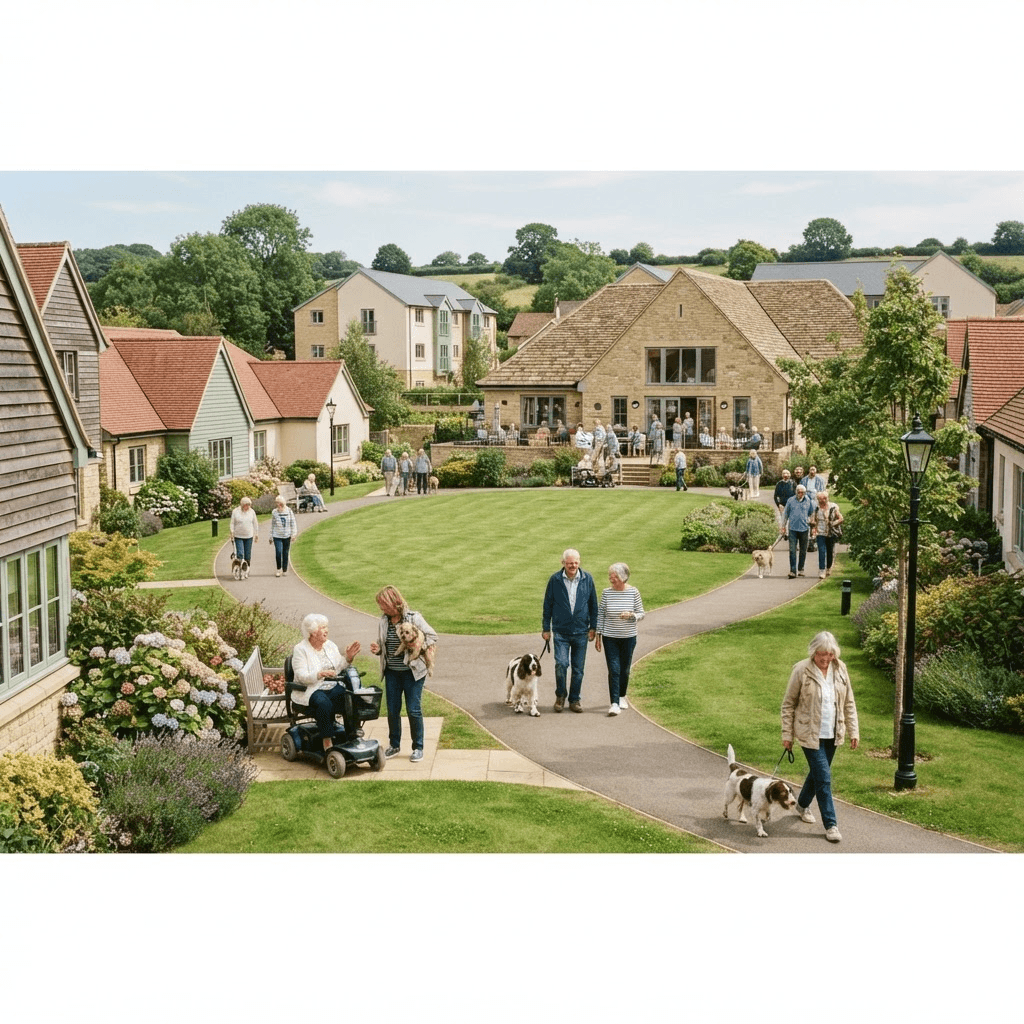
Retirement villages (increasingly called integrated retirement communities) are larger developments — often several hundred homes — combining private houses, bungalows or apartments with substantial shared facilities such as restaurants, bars, gyms, pools or activity programmes.
The care position varies more than in any other housing type: some villages operate a registered care service on site, others host visiting care providers, and some offer no care service at all. The village label alone tells you nothing reliable about care.
Fee structures deserve particular attention. Alongside service charges, many operators use deferred management or event fees — a percentage of the home's value payable on resale. These arrangements are legitimate but complex, and independent legal advice before buying is strongly advisable.
Terms used here: leasehold, service charge.
What to expect
Typical arrangements — the individual scheme or home always determines what is actually offered.
Your home
- A private house, bungalow or apartment, usually bought leasehold.
- Villages typically offer restaurants, lounges, gardens and organised activity.
- Larger sites may include gyms, pools, shops or health suites.
- Check with the operator exactly which facilities are included and which are charged.
Support and care
- Staffing varies from concierge-style teams to 24-hour emergency cover.
- Some villages run a registered care service; others rely on visiting providers.
- Domestic help and meals are often available as charged services.
- Check with the operator what care, if any, can be provided on site.
Costs, tenure and eligibility
- Most homes are leasehold purchases; some villages offer rental options.
- Service charges are typically higher than ordinary retirement housing, reflecting facilities.
- Deferred management or event fees on resale are common — take legal advice.
- Check with the operator the full fee structure, including on resale.
Is it likely to suit you?
There is no single right answer — these questions are meant to help you reflect, not to assess you.
- Do you want extensive shared facilities and organised community life?
- Would you prefer a house or bungalow rather than a flat?
- Have you compared the full fee structure, including any resale fees?
- Does the village's care position match what you may need later?
- Is the village's location practical for family, transport and health services?
Often confused with
Retirement villages or retirement housing?
Ordinary retirement housing is smaller in scale with fewer facilities and typically simpler fee structures.
The home
- Retirement villages
- A flat or bungalow in a single development.
- Retirement housing
- A private flat or bungalow in an age-restricted development, most often owned leasehold.
Care and support
No care service; care arranged privately if needed.
Retirement villages or extra-care housing?
Extra-care housing usually offers an on-site care team; in a village, care availability depends entirely on the operator.
The home
- Retirement villages
- Self-contained accessible flat in a care-staffed scheme.
- Extra-care housing
- An accessible flat within a larger scheme staffed by an on-site care team, rented or owned.
Care and support
Personal care usually available on site when needed.
Questions to ask providers
Worth asking about any scheme or home you are considering — print this page and take it with you.
What care, if any, is available on site — and is it registered?
The village label does not guarantee any care service.
What is the full fee structure, including deferred or event fees?
Resale fees can be a significant percentage of the home's value.
What do the service charges cover, and how have they risen?
Extensive facilities mean higher, faster-rising charges.
What happens if the operator changes or fails?
Village life depends heavily on the operator's stability.
Can you rent or trial before buying?
Some operators offer rental or trial stays.
What resale support does the operator provide?
Resale processes and timescales vary considerably.
Retirement villages currently listed
Approved listings of this type appear here as providers publish them. You can still search now — new homes are added regularly.
Search all retirement villagesKeep going
Choosing later-life housing: a practical guide
A practical guide to weighing up support, tenure and cost across the main housing types.
Related information and sources
Related reading
Sources and review
Reviewed by ShelterFind Editorial Team on . This explainer describes typical arrangements; details vary by scheme, provider and nation.